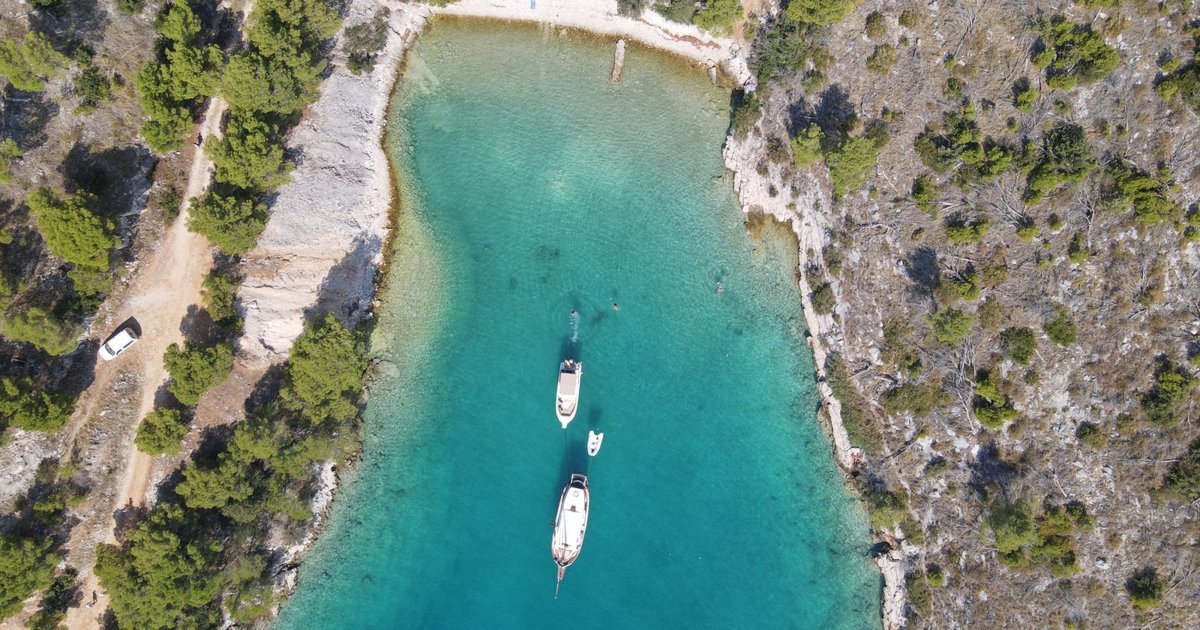
Croatia looks different from the water. From the coast road you see the islands; from a boat you get to stop at them. You can drop anchor in a pine-fringed cove with nobody else around, swim straight off the back of the boat, reach beaches that have no road at all, and wander into a small island harbour town for lunch before moving on. The best part is that the day is yours — you decide when to stay longer and when to head somewhere new.
Renting a boat for the first time can feel complicated: licences, skippers, fuel, deposits, who you pay and when. None of it is difficult once you know what to look for. This guide walks through it in the order you will actually meet it, from choosing a boat to handing back the keys.
How boat rental works in Croatia
Most day rentals follow the same basic path:
- Choose a destination and find a boat that suits your group.
- Pick a date and check whether you need a skipper or a licence.
- Review the price, then book.
- Receive meeting details from the operator.
- Meet the operator for the handover and safety briefing.
- Enjoy the day, then return the boat at the agreed time.
Boats in Croatia are generally rented from independent local operators — family businesses, small fleets and skippers. Each sets their own procedures, inclusions and terms, so two boats that look similar can work quite differently. Reading the individual listing is always worth the few minutes it takes.
What type of boat should you rent?
For a day trip, the common choices are:
- Small motorboats — simple, economical and easy to handle. Good for couples or small groups staying fairly close to the departure point.
- RIBs (rigid inflatable boats) — quick and stable, with easy swimming access. They usually offer little shade.
- Bowriders and open day boats — more seating and sunbathing space, often with a sun canopy and swim platform.
- Larger day boats — more comfort, shade and storage for families or bigger groups, and often rented with a skipper.
What to think about
- Passengers: stay within the stated capacity, and remember that a full boat feels smaller than it sounds.
- Shade: a canopy or bimini makes a long summer day far more comfortable.
- Swimming access: a swim platform and ladder make getting in and out easy.
- Storage: space for bags, towels and a cool box.
- Engine and distance: a longer route may need more power and more fuel; a short coastal day does not.
- Skipper and licence requirements: these can rule some boats in or out for you.
Choose the boat you are comfortable with, not the most powerful one available. A smaller, easier boat usually makes for a more relaxed first day.
Do you need a boat licence in Croatia?
If you rent with a skipper, the skipper operates the boat and you travel as a passenger, so your own qualifications are not normally the deciding factor. If you want to drive the boat yourself, an appropriate certificate may be required depending on the vessel and the applicable Croatian rules, and a foreign certificate may need to be one that Croatia recognises.
The operator may also have their own experience or insurance requirements, and decides whether to hand the boat over without a skipper. For the details, see our guide Do You Need a Licence to Rent a Boat in Croatia?
Should you rent with a skipper?
A skipper operates the boat, handles navigation and mooring, keeps an eye on the weather and knows where the good swimming spots and quiet coves are. On some boats a skipper is required; on others it is optional.
Many first-time visitors choose a skipper because:
- No licence is needed from you.
- You get local knowledge of coves, beaches and lunch stops.
- Navigation, anchoring and mooring are handled for you.
- Everyone in your group can relax and swim.
Experienced, qualified boaters often prefer to drive themselves for the independence. Neither option is better for everyone — it depends on your experience, your group and the kind of day you want.
How much does it cost to rent a boat in Croatia?
Prices vary widely with the boat, the destination, the season and the date. The advertised daily price is the starting point, but it may not include everything. Depending on the listing, your total can involve:
- The boat rental itself
- A skipper, if not included
- Fuel, if not included
- Cleaning, where the operator charges for it
- A refundable security deposit
- The CroatianBoats Booking Fee
- Optional extras
On CroatianBoats, once you select a date the listing shows the price for that specific day, since operators can set different prices for seasons, weekends or individual dates. For a fuller breakdown, read How Much Does It Cost to Rent a Boat in Croatia?
The Booking Fee vs the boat rental
This is the part first-timers most often mix up, so it is worth being clear about how CroatianBoats works. CroatianBoats does not collect the operator's rental price.
CroatianBoats Booking Fee
Paid to CroatianBoats when you complete your booking. Shown before you pay.
Boat rental
Paid directly to the independent operator, under the payment terms on the listing.
Security deposit
If required, handled separately by the operator. Not collected or held by CroatianBoats.
Some operators also ask for an advance rental payment. That is part of the rental and is credited toward the rental total — it is different from a security deposit, which is returned after the rental under the operator's terms. CroatianBoats does not hold, guarantee or insure rental money or deposits; those arrangements are between you and the operator.
What about fuel?
Fuel policies vary. Some listings include fuel; others charge for what you use, typically by refilling or measuring at the end of the day. How much you use depends on the boat, the engine, the distance, your speed and your route — a lazy day between two nearby coves uses far less than a fast island run.
Check the fuel policy on the individual listing rather than assuming it is included.
What is a security deposit?
A security deposit protects the operator against damage or loss. Amounts vary by boat and operator, and some boats do not require one. It is usually collected by the operator at check-in and returned after the rental, according to the operator's terms.
Where should you rent a boat in Croatia?
The coast is long, and each area has its own character:
- Split — a busy hub with easy access to Brač, Šolta and the islands beyond.
- Hvar — lively town, with the Pakleni Islands just offshore.
- Dubrovnik — the Elaphiti Islands and dramatic southern coastline.
- Zadar — a gateway to a wide, quieter archipelago.
- Šibenik — sheltered channels and many small islands.
- Trogir — a compact starting point close to Čiovo and the Split islands.
- Pula and Rovinj — Istria's coastline, coves and small islets.
For a side-by-side comparison, see Best Places to Rent a Boat in Croatia: 8 Destinations Compared, or browse all Croatian destinations.
What time should you start your boat day?
Many people like to set off in the morning. In summer, the middle of the day can be hot, popular coves fill up as the day goes on, and in many areas the sea is often calmer earlier — though this varies by place and weather.
Plan your route around the time you actually have, including the trip back. Returning by the agreed time matters, and your operator can tell you what is realistic from their harbour on that particular day.
What should you bring?
For the day
- Swimwear and towels
- Sunscreen, hat and sunglasses
- Plenty of water
- Snacks or lunch
- Footwear suitable for a boat deck
Documents and tech
- Phone and a portable charger
- Identification
- Your boating qualification, if driving yourself
- Any documents the operator has asked for
Some boats already carry snorkelling gear, a cool box or other equipment — check the listing so you don't pack what is already on board.
Weather and sea conditions
Conditions on the Adriatic can change during the day, and wind can make a crossing that was easy in the morning uncomfortable in the afternoon. Operators and skippers watch the forecast closely and may adjust the route, delay departure or cancel for safety reasons.
Follow their guidance — they know their local waters. What happens to your rental payment in that situation depends on the operator's terms, so it is worth reading them in advance.
What happens when you meet the operator?
The handover is usually relaxed and takes a short while. Expect:
- Meeting at the agreed point — a marina, harbour or quay
- An identity check, plus a licence check if you are driving
- A walk around the boat, noting any existing damage
- Where the safety equipment is kept
- How the controls, anchor and swim ladder work
- The fuel policy and the security deposit, if any
- Route suggestions and areas to avoid
- The return time and how to contact the operator during the day
Ask anything you are unsure about. Operators would much rather answer a question at the dock than out at sea.
During your boat day
- Follow the navigation and safety rules the operator explains.
- Respect protected areas and any local restrictions.
- Slow down near beaches, harbours and wherever required.
- Give swimmers and anchored boats plenty of space.
- Never operate the boat after drinking alcohol or while otherwise impaired.
- Follow your operator's or skipper's instructions.
Returning the boat
Aim to be back at the agreed time. If the fuel policy asks you to refuel, do that first. The operator will check the boat's condition and the equipment, and handle your security deposit according to their terms. Procedures vary between operators, so follow the instructions you were given at handover.
First-time mistakes to avoid
First-time renter checklist
Before you book
- Choose your destination
- Confirm your passenger count
- Check the boat's capacity
- Check licence requirements
- Decide whether you need or want a skipper
- Review the rental price
- Check the fuel policy
- Check the security deposit
- Review the Booking Fee
- Read the operator's cancellation terms
Before you leave the dock
- Bring the required documents
- Confirm the return time
- Understand the fuel policy
- Locate the safety equipment
- Understand the boat's controls
- Know how to contact the operator
- Check the weather and route with the operator or skipper
Your first Croatian boat day, step by step
- 1
Choose your destination
Pick a departure point that suits the islands or coastline you want to see.
- 2
Find a boat
Compare boats by size, capacity, shade and what's included.
- 3
Check skipper and licence requirements
Decide whether you'll take a skipper or need an accepted qualification.
- 4
Select your date
The listing calendar shows which dates are available and the price for each day.
- 5
Review the rental price and Booking Fee
The rental, any deposit and the Booking Fee are shown separately before you pay.
- 6
Complete your booking
Instant Book holds your dates while you pay the Booking Fee; Request to Book waits for the operator to accept first.
- 7
Receive operator and meeting information
Your booking page shows the details you need for the day.
- 8
Meet your operator
Handover, safety briefing and a walk around the boat.
- 9
Enjoy the Adriatic
Swim, explore and follow your operator's or skipper's guidance.
- 10
Return the boat as agreed
Back on time, with any fuel and deposit handled as agreed.
You can find a boat by destination, date, passengers and skipper preference, and see how CroatianBoats works before you book.
Frequently asked questions
- Is it easy to rent a boat in Croatia?
- For most travellers, yes — especially with a skipper. The main things to sort out in advance are who will operate the boat, what the price includes, and the operator's payment, deposit and cancellation terms.
- Can tourists rent boats in Croatia?
- Yes. Many independent operators rent day boats to visitors. Whether you can operate the boat yourself depends on the vessel, the applicable Croatian rules and whether you hold a qualification the operator accepts.
- Can I rent a boat without a skipper?
- Some boats are offered without a skipper. You will usually need an appropriate, recognised boating qualification, and the operator decides whether to release the boat to you. Check the listing and confirm with the operator before booking.
- Do I need a licence?
- Not if a skipper operates the boat. If you want to operate it yourself, a recognised certificate may be required depending on the vessel. Our licence guide explains how this is usually handled.
- Is fuel included?
- It depends on the listing. Some operators include fuel, others charge for what you use. Check the individual listing rather than assuming.
- Do I pay the entire rental through CroatianBoats?
- No. CroatianBoats collects only its separate Booking Fee. The boat rental is paid directly to the independent operator under the operator's payment terms shown on the listing.
- What is the CroatianBoats Booking Fee?
- A separate fee paid to CroatianBoats when you complete a booking. It is shown before you pay and is not part of the rental price you pay the operator.
- Do I need a security deposit?
- Some operators require a refundable security deposit; others do not. If required, it is handled directly by the operator — CroatianBoats does not collect or hold it. The amount and terms are shown on the listing.
- What should I bring?
- Swimwear, towels, sun protection, water, snacks, a charged phone, identification and any documents the operator asks for — including your boating qualification if you are operating the boat yourself.
- What happens if the weather is bad?
- The operator or skipper may change the route, delay departure or cancel for safety reasons. What happens to your rental payment depends on the operator's terms; Booking Fee treatment follows the CroatianBoats Terms and Refund Policy.
- Can I visit multiple islands in one day?
- Often, depending on where you depart from, the boat, the sea conditions and how much time you want to spend swimming rather than travelling. Ask the operator or skipper what is realistic.
- When should I book a boat for summer?
- July and August are the busiest months, so booking ahead gives you more choice of boats and dates. Shoulder months are usually more flexible.